|
|
Outline
|
|
Prologue
For the purpose of understanding the mechanisms of atmospheric variation causing global warming, the JAL Foundation has participated in atmospheric observations using commercial airliners.
These observations began in 1993 and used Classic Boeing 747 aircraft. At the time of the retirement of the aircraft, new observation (measuring) equipment was developed and installed in new airliners, which inherited the atmospheric observation program.
The purpose of the observation by airliners, the background and significance of the new atmospheric observations, the development system and a summary of the uses of the obtained data will be introduced.
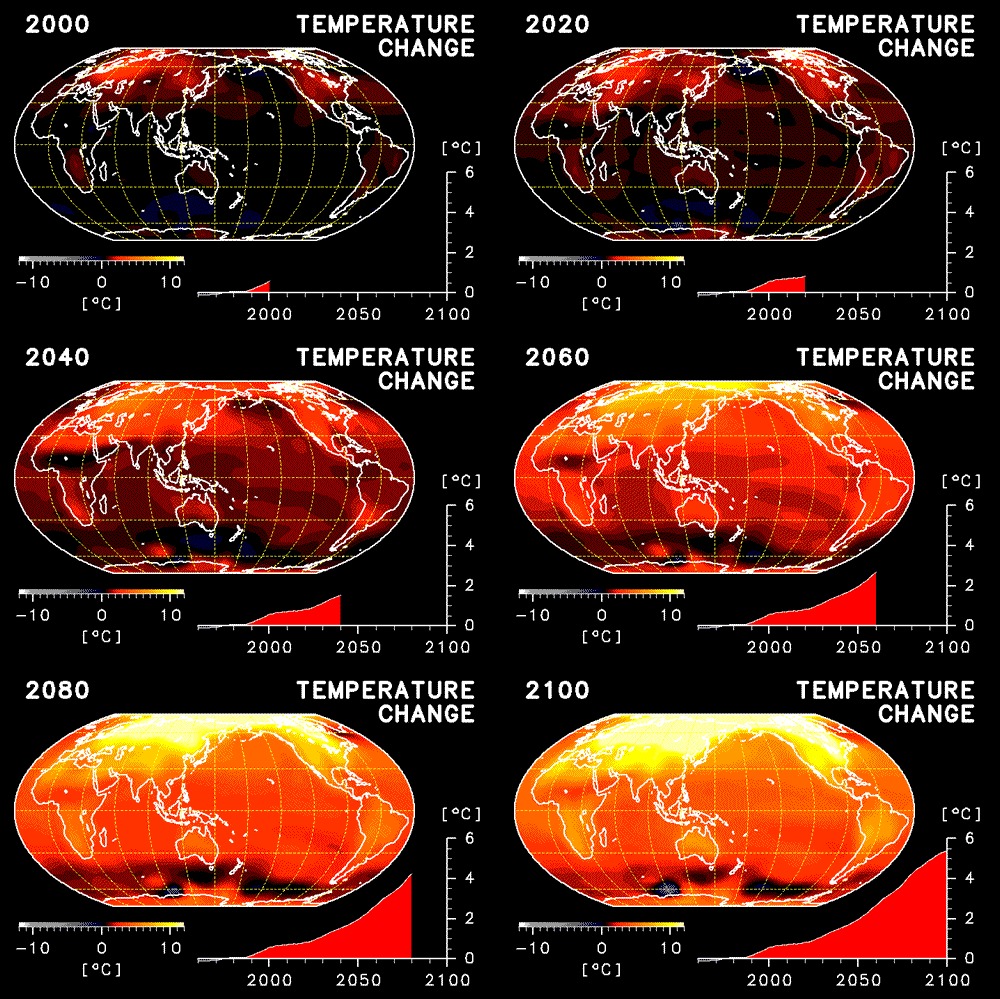
In terms of the earth's environment, numerous issues have been raised, including global warming, the deterioration of the ozone layer, acid rain, deforestation and desertification. The earth atmospheric observations of the current project targets the "Global Warming Problem", which has become a topic of social interest in recent times. The main purpose is to obtain basic data on the concentration of greenhouse gases such as carbon dioxide (CO2), which are linked to human activity since the industrial revolution. It is hoped that data obtained over a large area and at a high frequency will provide a basis from which the mechanism of variation and circulation of the greenhouse gases will be elucidated.
/image10.jpg)
Annual Latitudinal Change of CO2 Concentration at Ground Level
(Source : Japan Meteorological Agency)
/image20.gif)
/image18.gif)
/image23.gif) |
/arw008.gif) |
/b747_400.jpg) |
|
|
/arw005.gif) |
||||
|
||||
| Past observations | Observations using Commercial Airliner | Various Uses |
| The Aim of Atmospheric Observations by Commercial Airliner |
In order to promote an effective strategy against the consequences of global warming, it is necessary to accurately predict the weather patterns of the future. It is important to understand the emission and absorption rates of individual regions and the effect this has on climate change. This can be achieved by accurately recording the concentration and distribution of atmospheric greenhouse gases which impact upon the temperature at earth surface.
Of the greenhouse gases, CO2 is the largest in quantity and effect and is increasing rapidly due to use of coal and oil as well as deforestation. Because of this, great interest has been shown in the exchanges of CO2 between the atmosphere and the terrestrial biosphere, and the atmosphere and ocean.
The fluorocarbon gases (CFC, HCFC) and sulfur hexa-fluoride(SF6) are man-made greenhouse gases and thus the emission quantity and original distribution are easily determined by statistics. However, global levels of CO2 circulation, natural and human emission and absorption, and regional levels are largely indeterminate. Therefore, in order to increase the reliability of future greenhouse gas concentration and distribution predictions, it is important to perform accurate observations of CO2 on a regular basis, over a large area and with high accuracy. Observations of greenhouse gases from land were first conducted in the Mauna Loa, Hawaii in 1958. Today, there are more than 100 locations where various countries and organizations conduct observations. In recent years, in order to gain an understanding of three-dimensional greenhouse gas fluctuation, mobile transportation such as aircraft and ships have been used, as well as air balloons. However, examples of observations using aircraft were few in number and were generally conducted using charter flights, meaning a number of restrictions including cost existed when attempting to conduct scheduled and long term observations over large areas on a frequent basis. Thus, the practice of installing measuring devices onto commercial airliners that regularly commute on international flight routes is a highly attractive option.
(For information on greenhouse gases and observation systems, see "Additional Material (Related to Atmosphere)")
Circumstances
Between April 1993 and December 2005, the JAL Foundation and Japan Airlines have observed the concentration of greenhouse gases in the upper atmosphere from Australia to Japan. Air samples were collected approximately two times per month and the data was analyzed by the Meteorological Research Institute. Many insights were gained into the fluctuating concentration and atmospheric circulation of CO2, methane (CH4) and carbon monoxide (CO) in the upper atmosphere (approximate altitude 10,000 meters) of the southern and northern hemispheres.
These observations were the first to be conducted over a large area and at a high frequency using scheduled commercial airliners. Similar observations using commercial airliners (airbus) began in Europe, with France and Germany at the core. (For detailed information, see Previous Observations)
Under such circumstances, the two Classic Boeing 747 aircraft that had been used for the observations neared their retirement. Thus, in September 2003, in order to continue the observations and further develop them, the New Atmospheric Observation project commenced. At this time, the public was increasingly expressing interest in the global warming problem and at the Earth Environment Summit, the much attention was given to the importance of Global Earth Observing System of Systems (GEOSS).
This project operates under the cooperative partnership of academic institutes and industries, and with financial assistance from the Ministry of Education, Culture, Sports, Science and Technology. In approximately two and an half years up until March 2006, two new atmospheric observation equipments were developed, and installed onto new aircrafts (Boeing 747-400, Boeing 777 and experimental aircrafts owned by the Japan Aerospace Exploration Agency), and a plan to commence trial observations was drawn up.
The Continuous CO2 Measuring Equipment (CME) that has been newly developed for the New Atmospheric Observations is able to continuously measure CO2. Below are the characteristic features of this new equipment which were not possible in the past.
/cme.ht7.jpg) |
/cme.ht6.jpg) |
1. Data can be obtained not only whilst flying horizontally but also during climb and descent. Thus, the vertical distribution of CO2 can be observed. 2. Because measurements can be made continuously, detailed observations of atmospheric distribution are possible. 3. The number of observations will dramatically increase compared to those of the past due to the frequency in daily commercial flights. 4. Observations will become possible not only on the Australia route but also on other routes operated by Japan Airlines (such as Asia, North America, the Atlantic and Europe) |
|
| CME | |||
These characteristics of the CME give way to the merits mentioned below. Additionally, it is hoped that the CME will allow for an improvement in accuracy of the three-dimensional transport model, verification of the data obtained by the Greenhouse Gas Observation Satellite(GOSAT,OCO) to be launched by Japan and the US in 2008, and verification of the various measures within the Kyoto Protocol.1. CO2 observations in East Asia and Southeast Asia, which are insufficient observation zones, can be constantly conducted.
2. This will become highly valuable data, especially from tropical regions, since yearlong vertical distribution observations have never been conducted in the past.
3. It will allow for a rise in the accuracy of prediction of absorption and emission across the continents.
4. There is an expectation that Japan will be able to become the world leader in the field of observation of greenhouse gases via airliners.
5. Useful information will be obtained in regards to atmospheric transportation (exchange between the southern and northern hemispheres, vertical transportation, etc.)
Furthermore, the improved Automatic Air Sampling Equipment (ASE) is now able to sample the air at any spontaneous location. In addition to CO2, CH4 and CO analyzed in the previous project, the sampled air will be analyzed for Nitrous Oxide (N2O), Hydrogen (H2), Sulfur Hexa-Fluoride (SF2) and carbon isotope (13C/12C) and oxygen isotope (18O/16O).
/ase2.JPG) |
Note: |
|
| ASE |
Development System and Structure
The New Atmospheric Observation Project developed new atmospheric observation equipments (CME, ASE) and, with the approval of the Japanese and US Aviation Authorities, made plans to install these onto two new types of aircraft. The project was conducted with the aim of creating new proposals for the monitoring of greenhouse gases using commercial airliners and to establish a world standard for these procedures. This project is much more advanced than its predecessors and, as it goes beyond what can be done by a single private enterprise, it is being conducted with the knowledge and experience of related ministries, and with the cooperation of both academic institutes and industries.
The development of measuring equipment and the modification of the aircraft occurred in partnership with related organizations and with financial assistance from the Ministry of Education, Culture, Sports, Science and Technology (Scientific Technology Development and Adjustment Fund : Program Name "Promotion of an Effective Partnership of Academic Institutes, Industries and government"). In November 2005, a new measuring device design and approval to install the equipment onto JAL Boeing 747-400s was obtained. (For further reading see chart below and Progress of the New Atmospheric Observation Project)
By February 2006 measuring equipment was installed on the second 747-400 model aircraft. In late March 2007, the certification for the first Boeing 777 model aircraft was obtained to install the measuring device. Modification and installation occurred on two more aircraft of this model, and currently, as was planned, five airliners conduct observations.
Furthermore, in addition to the five aircraft owned by Japan Airlines, observation equipment is installed on an experimental aircraft owned by the Japan Aerospace Exploration Agency (JAXA). This aircraft focuses its observations on the Sagami Bay area.
During this time, for the purpose of actualizing the benefits of the creation of the New Atmospheric Observation project plan, new measuring equipment and an airliner observation platform, a cooperative committee including external experts, known as the "Committee on promoting the Observation to Investigate atmospheric Composition by Regular Airline Flights", was created in November 2003. This committee met on a total of seven occasions up until September 2006, and was dissolved after completing its main tasks of obtaining approval for the project and collecting observation data.
Henceforth, a new committee will continue the work and aim to maintain the observation platform and promote the effective use of observation data.
/organization.gif) |
|
| Organization Name | Roles of each organization |
| JAL Foundation | It is responsible for management of the whole program, along with conducting essential investigations to develop the measuring equipments and the airplane modification. |
|
Tohoku University |
It is responsible for developing an analyzing programs to manage the ever-increasing volume of data to be obtained from the automatic continuous CO2 measuring equipment, and also giving advice and guidance from a scholarly point of view. |
| National Institute for Environmental Studies (NIES) | It is responsible for the development of the measuring equipments, and installing processes of these equipments onto the airplanes. Also responsible for conducting the actual observations and analysis of both the sample air collected by the automatic air sampling equipment and the results of observations measured by the automatic continuous CO2 measuring equipment. |
| Japan Aerospace Exploration Agency (JAXA) | It is responsible for the modification of its own airplane to load the automatic continuous CO2 measuring equipment. It also assesses prospective future functions of the equipment, investigates application methods, and conducts continual observations. |
| Meteorological Research Institute(MRI) | It is responsible for part of the development of the automatic air sampling equipment and assisting the analysis of the sample air collected by the automatic air sampling equipment. |
| Japan Airlines(JAL) | It will install the measuring equipments
onto its own airplane and be in charge of following items: 1).to investigate
the way to install these equipments, 2). to investigate and develop the
methods to obtain the various information from the airplane, such as latitude/longitude
at each measuring point, 3). to modify their airplanes, 4). to conduct
the regular observations. Also JAL will advise the NIES of their various duties and will share some part of business with JAMCO. |
| JAMCO | It supports the various works
done by JAL Foundation and the NIES in the following ways: 1). to investigate
and develop to add durability for the measuring equipments to make it
strong enough to load on the airplane, 2). to investigate the testing
procedures to obtain the certification for the measuring equipment to
load on the airplane, and execute these tests, 3). to design the airplane
modification and to obtain certification from the governmental authority. It will also be responsible for various procedures and the practical side of operations done by the NIES. |
Atmospheric observations conducted using the Classic 747 aircraft models utilized the Automatic Air Sampling Equipment (ASE), pictured below.
/p2.jpg) |
/212.jpg) |
|
|
Atmospheric Observations using Classic 747 aircraft
|
||
An improved ASE and a new Continuous CO2 Measuring Equipment (CME) were developed for the New Atmospheric Observation project. The observation techniques and experience gained from the already existing equipments, as well as previous knowledge of designing and manufacturing, were utilized when manufacturing the new equipment. JAMCO supervised the development and manufacture of the new equipments with guidance from the NIES and the MRI, as well as organizations familiar with observing atmospheric composition.
The improved ASE has had slight upgrades from the previous ASE. It also has additional automatic features such as operating at a spontaneous location taking into account of the aircraft position information (latitude, longitude, altitude) which was obtained from existing airborne systems. Furthermore, the improved ASE was subject to strict design requirements such as having suitable mechanical strength as an aircraft part, and not jeopardize the safety of the airplane by electromagnetic interference etc. Moreover, although the newly developed CME utilizes the same methods as its predecessor in terms of basic measurement of CO2 concentration and maintenance of accuracy using standard gases, there were no instances where components for the aircraft were similar, and thus the development began from the designing of basic parts.
/image47.gif) |
/image46.gif) |
|
|
Environmental test (Left: electromagnetic interference test, Right: low pressure test) |
||
The measuring equipment steadily satisfied these strict requirements and in spring 2005, with FAA inspectors present, a compulsory environmental test (vibration/impact resistance, heat resistance, pressure resistance, electromagnetic interference resistance, etc.) for devices to be installed on the aircraft was conducted. We were able to safely pass all of these tests. This signifies the completion of a major hurdle in the lead up to the integration test for the equipment, which will occur after the aircraft is modified.
The New Atmospheric Observation project modifies Boeing 747-400 and 777 models owned by Japan Airlines and installs newly developed atmospheric measuring equipment onto them. It was convenient to not have to repeatedly go through the same process each time measuring equipment was installed on a particular model airliner. Thus, it was decided that a design approval for installing of equipment on aircraft and a basic approval for aircraft modification designs needed to be obtained. In order to do this, an US subsidiary company of JAMCO, Jamco America Inc, requested an approval for supplemental type certificate (STC) from the US and Japan Aviation Authorities.
|
|
/b747400_ase.jpg) |
|
New Atmospheric Observation equipment installation (left: CME, right: ASE) |
|
The modification of the first Boeing 747-400 model (registration number JA8917) was conducted in October 2005. A test flight to confirm the safety of the aircraft modification and measuring equipment installation was conducted and following this, on 26 October 2005, the STC was obtained from the FAA. On 2 November 2005, the supplementary type certificate was obtained from the Ministry of Land, Infrastructure and Transport(MLIT). Modification of the Boeing 777 model also occurred, taking place in March 2006, and approval was gained from the US and Japanese Aviation Authorities in late-March after a test flight was undertaken. (Approval from the FAA on 22 March 2006, from the MLIT on 31 March 2006.)Additionally, in February 2005, operations were undertaken to install the CME on a Beechcraft 65-model airliner (JA5111), owned by the JAXA. On 21 February of the same year, the MLIT's repair and modification test was passed
/image1.jpg)
/image38.gif)
Supplemental Type Certificate (STC)
In November 2005, observations using the newly developed measuring equipment began. The commencement of the routine observations resulted in the obtaining of large amounts of useful data. An example is introduced below.
The top graph compares the CO2 concentration data obtained by the CME and ASE on flights between Sydney and Narita. It can be seen that the two sets of data align well, and that finer details of concentration distribution can be obtained by the CME, which can, unlike the ASE, make continuous observations.
The bottom graph displays the vertical distribution of the CO2 concentration in the areas surrounding Narita and Jakarta airports. Difference of the concentration at ground level and the altitudinal concentration incline of both airports can be observed well.For other detailed data, please see here.
/image24.gif) |
| Comparison of CO2 concentration observed by the ASE and CME |
/vert%20profile.gif) |
| Vertical distribution of CO2 concentration in the vicinity of Narita and Jakarta airports |
In the New Atmospheric Observations, the number of aircrafts onto which the measuring equipment is installed has increased in number and the observation flight routes have expanded. Because of this, massive amounts of data will be obtained in the future.
With the support of the Earth Environment Preservation Research Funding of the Ministry of Environment, a cooperative body of companies affiliated with the production of the New Atmospheric Observation Project has been established. The core of this cooperative body is the NIES, and it maintains and manages (including service costs) the commercial airliner observation platform, as well as analyses, monitors and distributes the large amounts of data obtained by the project.
While the newly developed measuring equipments were being installed onto the five airliners operated by Japan Airlines, focus was placed upon verification of the accuracy of the data, the method of installing and removing the equipment, monitoring the quality of the equipment overall and improvement of the equipment.
At present, various preparations for the creation of a system of data use is being created, and routine flights will begin once the accuracy of the measuring equipment is confirmed and a quality management system is established. The "Committee on promoting the Earth Environment Observation by Regular Airline Flights", which includes members who have scholarly experience, will provide advice when announcing the results of and knowledge gained from the observation data.
Sections of these results will be reported on this web site in an easy-to-understand, timely fashion. Additionally, the above committee will additionally look into a method of distributing the finer details of the data.
Epilogue
As is stated above, the JAL Foundation will continue to work in cooperation with relevant organizations so as to maintain and manage the smooth operation of this observation platform. We have plans to introduce the information and results gained from the observation data in a broad fashion. We hope that you will understand and support us in our endeavors. Additionally, please submit any opinions about this project you may have.
/button1R.JPG)
Copyright©1996-2007 JAL FOUNDATION. All Rights Reserved.
/image32.gif)
/photo3.jpg)
/ryouikibunkatsu.jpg)
/image.gif)
/b747400_cme.jpg)